
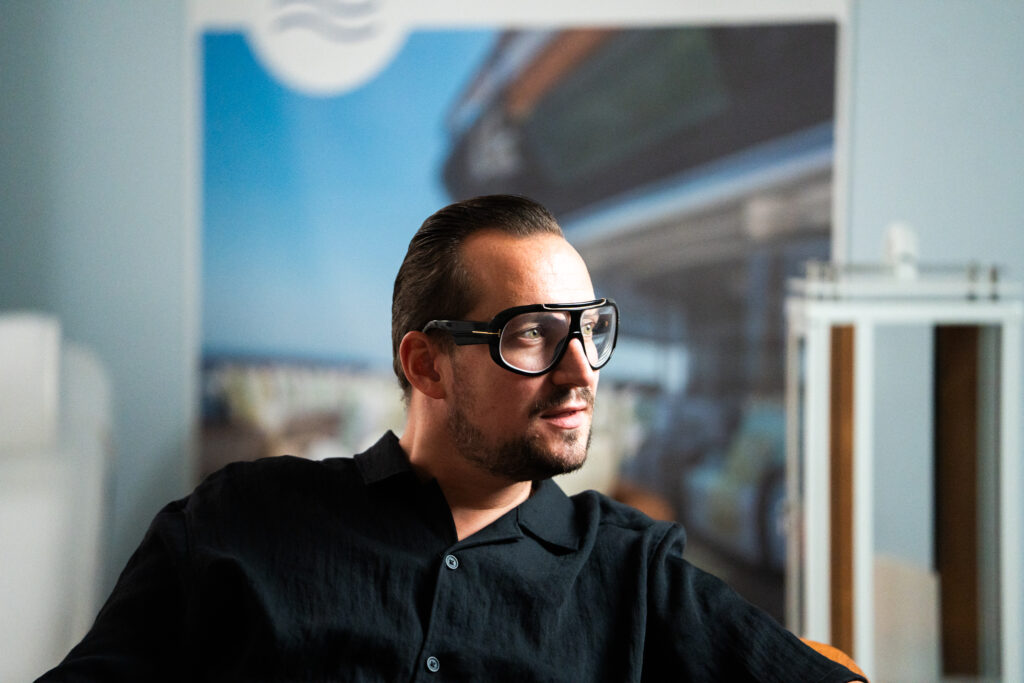
THE PORTRAIT by✦YACHTLLYWOOD
THE LAST FRONTIER OF SUPERYACHT DESIGN
MANUEL DEL COLOMBO AND OUTDOOR LIVING AT SEA
For decades, the superyacht industry perfected what happened inside. Interiors became increasingly sophisticated, engineering increasingly advanced, and naval architecture increasingly ambitious. Yet one of the spaces where owners and guests actually spend much of their time remained curiously conventional.
As life at sea moved outside, exterior spaces evolved from secondary terraces into some of the most important environments onboard. Mornings begin there, lunches stretch into afternoons, chefs cook in front of guests and evenings disappear into the horizon. Yet for years, the furniture inhabiting these spaces was selected from a catalogue.
For Manuel Del Colombo, that contradiction was difficult to ignore.
“You have a yacht that is a one-off, built for one owner, and then you put standard-range furniture on the deck. Our competitors were selling ranges. The owner was asking for something that does not exist yet. That gap is where we went.”
Today, as Co-Founder & Managing Director of SIEBENSEE, Del Colombo works at the intersection of craftsmanship, engineering and a changing philosophy of life at sea. His story, however, began far from the Mediterranean, in Nieheim, a small German town where his family’s furniture factory has been operating since 1958.
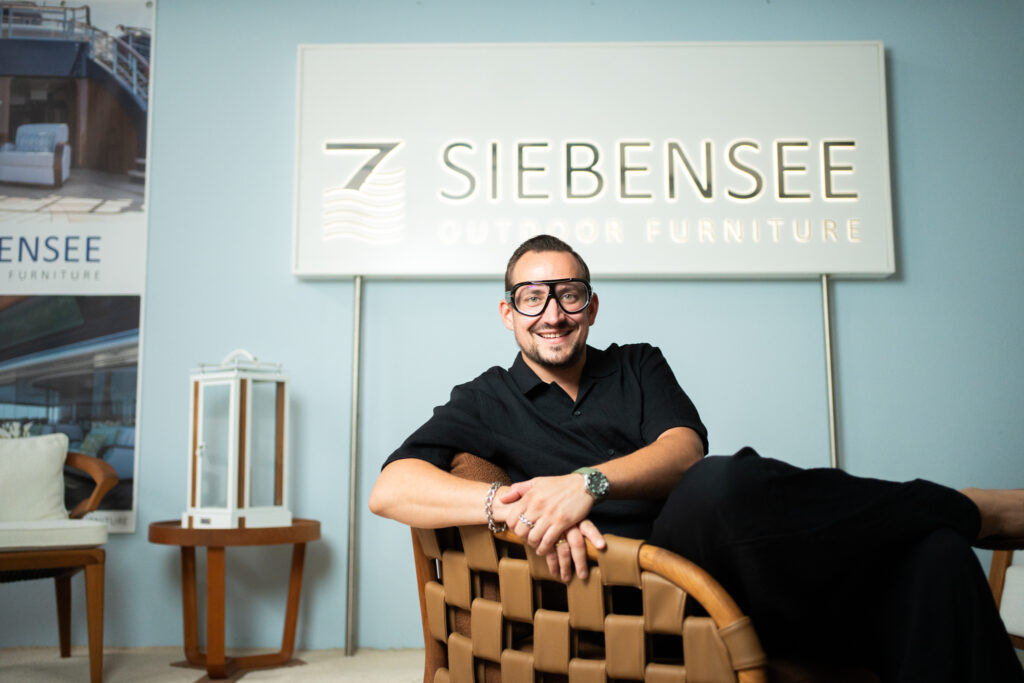
He grew up around wood, machines and craftspeople who had spent decades mastering the same profession. His parents produced high-end interior furniture for the retail market, and for a long time, that was sim- ply the family world. When Del Colombo and his brother Alexander took over the business, the landscape around them was changing. The European retail furniture market was declining, while enquiries from the yachting industry were becoming increasingly important.
There was no carefully orchestrated plan to enter superyachts. “So we followed the wood, not a business plan,” he says. “I never planned to end up on a superyacht deck. I just never stopped asking what else we could build.” That curiosity arrived at an interesting moment. The yachts Del Colombo encountered early in his career looked very different from those being launched today. Exterior areas were smaller, with relatively little loose furniture. As yachts grew, so did the amount of life happening outside.
Bars migrated onto the deck. Kitchens followed. Dining became more theatrical, with owners wanting the chef beside the table rather than hidden several decks away Lounging areas expanded. The exterior stopped being somewhere guests went after dinner and became somewhere they could spend the entire day. But while the way people lived onboard had changed, the thinking behind the furniture had not necessarily kept pace.
Technical excellence remains essential, but at this level it is also assumed. An owner expects the yacht to perform. What increasingly differentiates one yacht from another is how it feels to live onboard.
“Propulsion, engineering, eco-friendliness: all of that is taken for granted the moment somebody buys a yacht,” he says. “Nobody is going to brag about the engine. But the deck is the part everybody sees, from the water, from the next yacht, from the photos.”
It is a provocative way of putting it, but it reveals something important about contemporary yacht ownership. The exterior has become both living space and identity. Shipyards, in turn, have become braver. Del Colombo sees a greater willingness to propose something remarkable rather than something universally safe, particularly as owners become more involved in defining how their outdoor spaces should function. Yet the more effortless these spaces appear, the more technically demanding the furniture becomes.
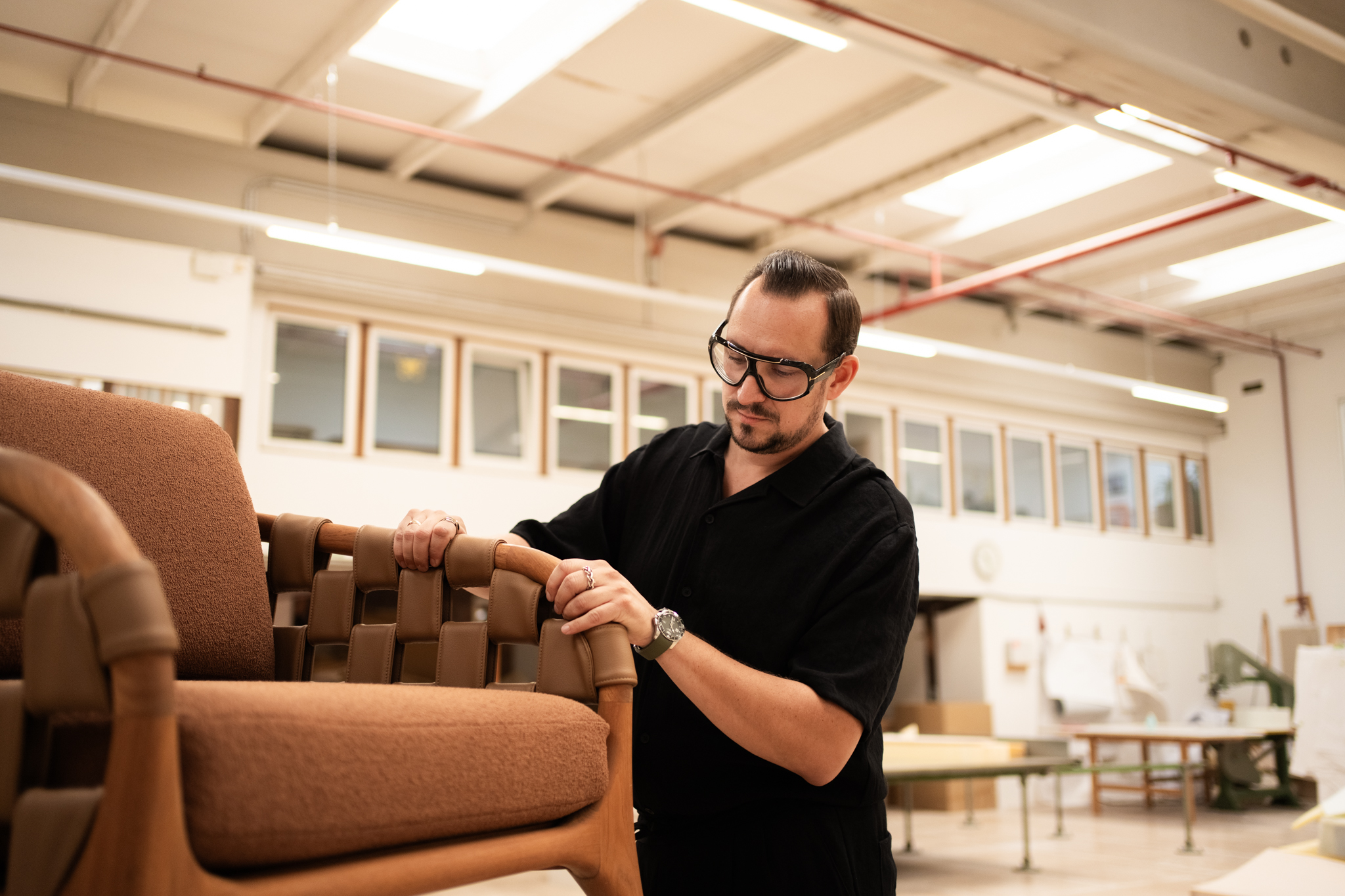
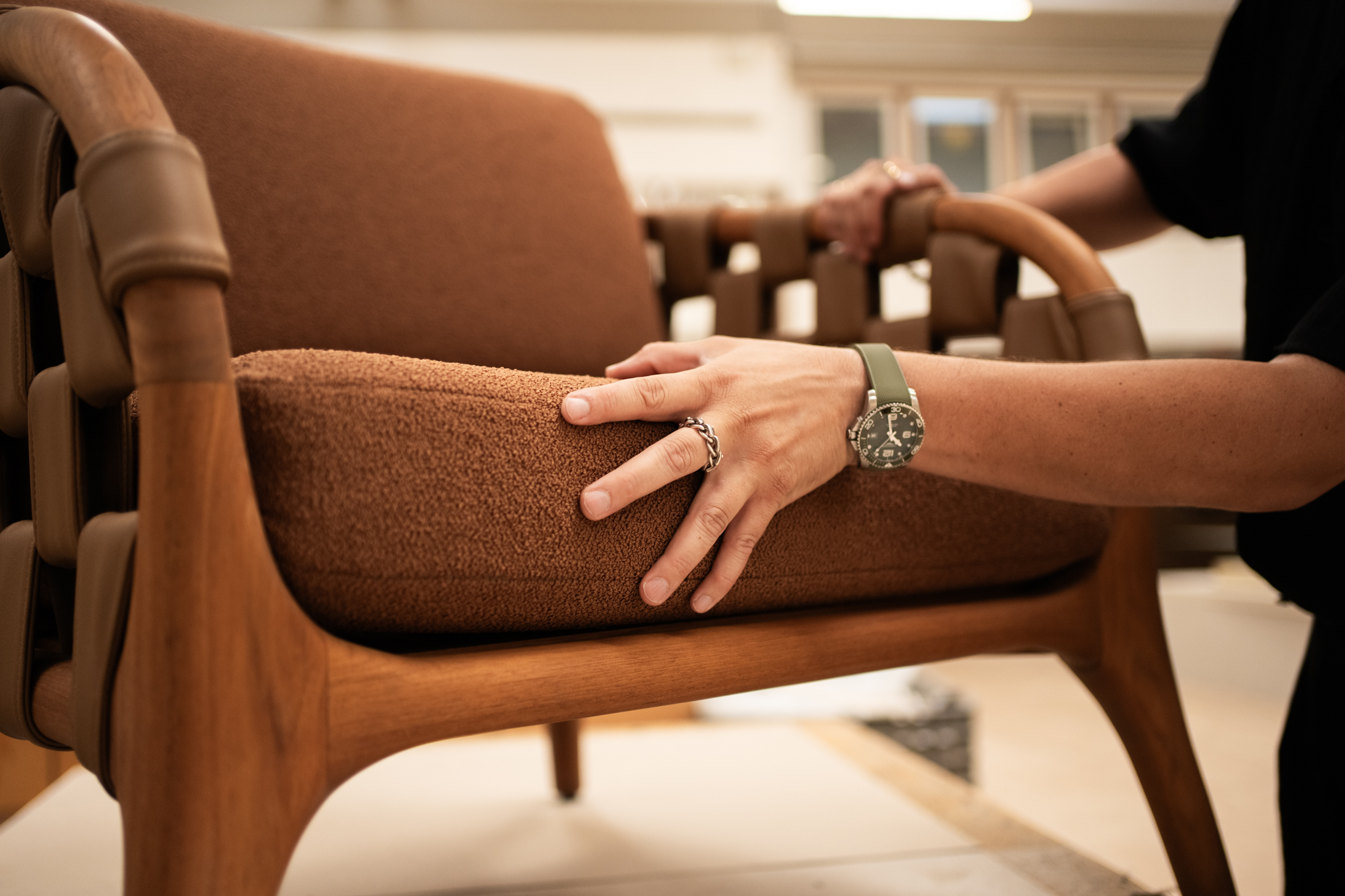
A chair on a yacht is never simply a chair. Salt, UV exposure, heat, moisture and constant movement all have an opinion on the designer’s sketch. Woods have to survive. Foams need to dry correctly. Joints must tolerate movement, and furniture must endure guests dragging, moving and using it season after season.
“Nothing on a deck stands still, that is the part people forget,” he says. “The design has to survive the sea, not a showroom.”
It is perhaps the line that best describes Del Colombo’s approach. Beauty is only successful if it survives the environment for which it was created.
Interior had decades of thinking behind it, exterior had almost none. And you cannot solve a whole deck with a chair.

The company brings together FINKELDEI’s expertise in loose seating furniture and STÜKERJÜRGEN’s knowledge of fixed furniture. Instead of treating tables, sofas, bars and built-in elements as separate categories, the objective is to consider the exterior as one environment. For years, this was not how the deck was treated. Exterior furniture often appeared towards the end of the budget, after the serious decisions surrounding engineering, naval architecture and interiors had already been made. That hierarchy is changing.
After two decades working in the sector, that under- standing has become almost instinctive. A drawing may be beautiful, but experience quickly reveals whether it will actually work at sea. It is one reason SIEBENSEE is increasingly involved earlier in conversations with designers, shipyards and owners rather than entering only when furniture needs to be supplied. Behind it remains the factory in Nieheim.
Del Colombo is careful not to romanticise the idea of German manufacturing. The hardwood itself comes from tropical regions. What happens afterwards is what matters to him. The company selects and purchases its raw wood before milling, joining, gluing, lacquering, assembling and controlling the furniture in its own factory. Around 85 to 90 percent of the value creation, he says, remains in-house. That control is becoming more significant as yacht-building schedules compress.
“We are fast and we always find a solution, but we will not buy speed with quality.”
The challenge was not simply technical. Del Colombo also had to transform a traditional family business, populated by people who had spent decades making interior furniture, into a company capable of thinking in yachts. And then he had to convince the yachting world. “In the beginning you are the furniture guy from Germany,” he says.
In an industry built heavily on relationships and reputation, credibility arrived project by project. Supplying furniture was one thing. Being trusted with the vision for an entire deck was another. Today, the direction of yacht design suggests that the opportunity he identified was larger than furniture itself. Del Colombo believes the next step is for the deck to stop feeling furnished at all. “In ten years the deck will not be the place you go after dinner, it will be the place the yacht is designed around.”
He imagines fewer visible interfaces, softer materials and exterior elements designed for one particular yacht rather than selected from a range. Shipyards are also increasingly looking for one partner capable of handling the complete exterior, reducing the complexity created when multiple suppliers meet on the same deck. Almost a decade ago, when SIEBENSEE began treating fixed and loose furniture as parts of one exterior project, the idea was unusual. Today, more players are following the same direction. Perhaps that is the clearest indication of how much the deck has changed. It is no longer the space left to furnish once the yacht has been designed.
“Our job for the next ten years is to stay the ones who read it right first.”
Image Courtesy of SIEBENSEE0